Wednesday, January 10, 2007

New Year's Reflections

2006 was an incredibly busy year, and I feel like we accomplished so much. But I find myself caught in a philosophical tug-of-war space between the elation of goals met and the daunting reality of how far we still need to move towards sustainability.

Lots of the things we did in '06 were big steps without immediate gratification:

  • we purchased our goats, but still no milk

  • we purchased pigs, but still no pork

  • we planted several fruit trees (in fall of '05 really) that are still years away from bearing fruit

  • we continued creating the infrastructure for homesteading and a farm-based business, but still not making any money (and maybe never will!)


Big goals accomplished:
  • built chicken coop

  • began fencing

  • butchered 20 of our own chickens

  • grew much of our own food

  • froze or put up lots of food

  • bought a side of beef from a local pasture-based farm


Little steps that added up (that I should have done long ago!):

  • improved our recycling thanks to county program expansion

  • switched from paper napkins to cloth

  • switched from paper towels to old hand towels

  • switched over to eco-friendly dishwashing tabs and laundry detergent

  • switched several bulbs over to cfl's

  • joined an organic purchasing club


Goals for 2007:

  • move further towards simplicity and sustainability

  • make Touch the Earth CSA a reality and not just a dream

  • grow more food

  • preserve more food

  • learn to make goat cheese and goat's milk soap

  • further reduce dependency on grocery chains

  • set up home-made pet-poo vermiposting system that I've been designing for ages

  • begin heritage poultry breeding program

  • improve goat breeding program by bringing in new lines

  • set up tamworth breeding program

  • set up heritage duck breeding program

  • start up Touch the Earth's "Vintage Farm" line of products


And I'm sure there's much, much more—there always is!

Thursday, November 23, 2006

Happy (American) Thanksgiving!

Trying to plan out my day, so I figured I'd do it here, then update with photos tomorrow.

We have two turkeys to cook:

one 10 1/2 lb. free-range heritage turkey from our own farm, which Jim killed on Saturday, so he's been sitting for a few days to tenderize and has been in the garage brining for the past 36 hours,

and one 13 lb. kosher bird from the grocery store because my mother-in-law refuses to eat a "backyard bird."


Mashed potatoes grown on our farm

Green beans grown on our farm

Green onions grown on our farm for seasoning and stuffing

Sweet potatoes

Candied carrots


My mother-in-law is bringing the candied carrots, a coconut-custard pie and an apple pie.

I'm trying to motivate and make the pumpkin and pecan pies that I like, but I'm not feeling terribly motivated at the moment, which is why I'm sitting here typing this list rather than actually making any of it.


Goals for next year:
Homegrown pumpkins, which the deer crushed this year
Homegrown sweetpotatoes
Homegrown carrots, which we had but already ate
Home"grown" whipped cream from our goats
Homegrown sausage for the stuffing (yup! brought our piggies home yesterday!)

Sunday, November 12, 2006

Food Blog

I've been inspired by all the delicious recipe posts and am trying to remember to take photos more often. Last week, I pulled out some pesto and oven dried tomatoes from my garden and sauteed them in olive oil with some garlic, coarse sea salt and pine nuts. Once done, I poured it all over cheese tortellini and served it with some homemade ciabatta bread. It was tasty, though the cheese tortellini weren't as tender as I would have liked. I miss having a place to purchase fresh pasta! I remember fondly the red pepper fettucine I used to be able to buy at DiSalvo's Pasta back in State College. Mmmmmm... Makes me almost crazy enough to want to buy that pasta attachment for my kitchenaid. Like I need one more thing to make from scratch!

Sunday, November 05, 2006

Homemade Waffle/ Pancake Mix

Though we'd been making our waffles from scratch for a while, somehow the lure of opening a box of Dr. Oetker's was strong, as it seemed so much easier to muster in the morning than starting from scratch. Why not mix up my own, I thought, so I could just unscrew a jar of dry ingredients, mix up the wet and voila! I purchased the basics and set about making my own mixes.

Before long, Jules joined me and ended up mixing nearly all of them herself! We had a great time in the kitchen together, and she's so thrilled when we use the mix she made. Although it really was just a few basic ingredients in the mason jars, cutting out that one step does seem easier than scratch. Slowly but surely, we're breaking away from our dependence on grocery chains. We've recently joined an organic coop, which should make getting the staples I can't buy locally even easier, and buying in bulk not only means money saved on the food items but also translates into less gas used, less money spent on gas and transport, and less money into the Giant corporation. Woohoo!

Sunday, October 15, 2006

First Frost

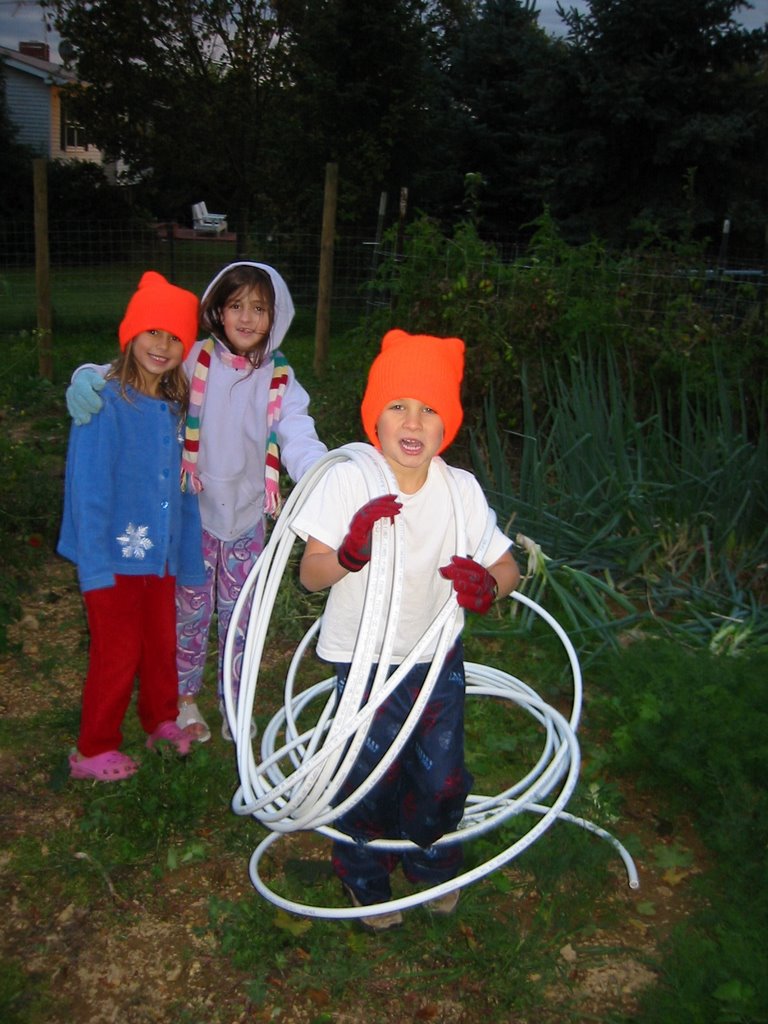
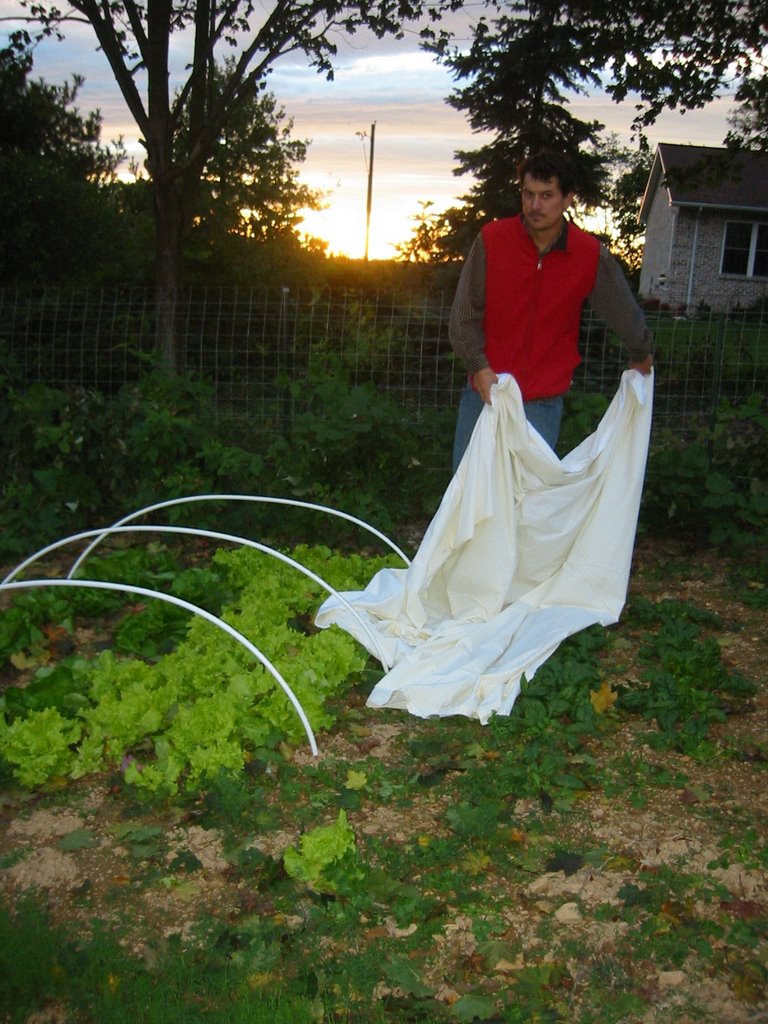
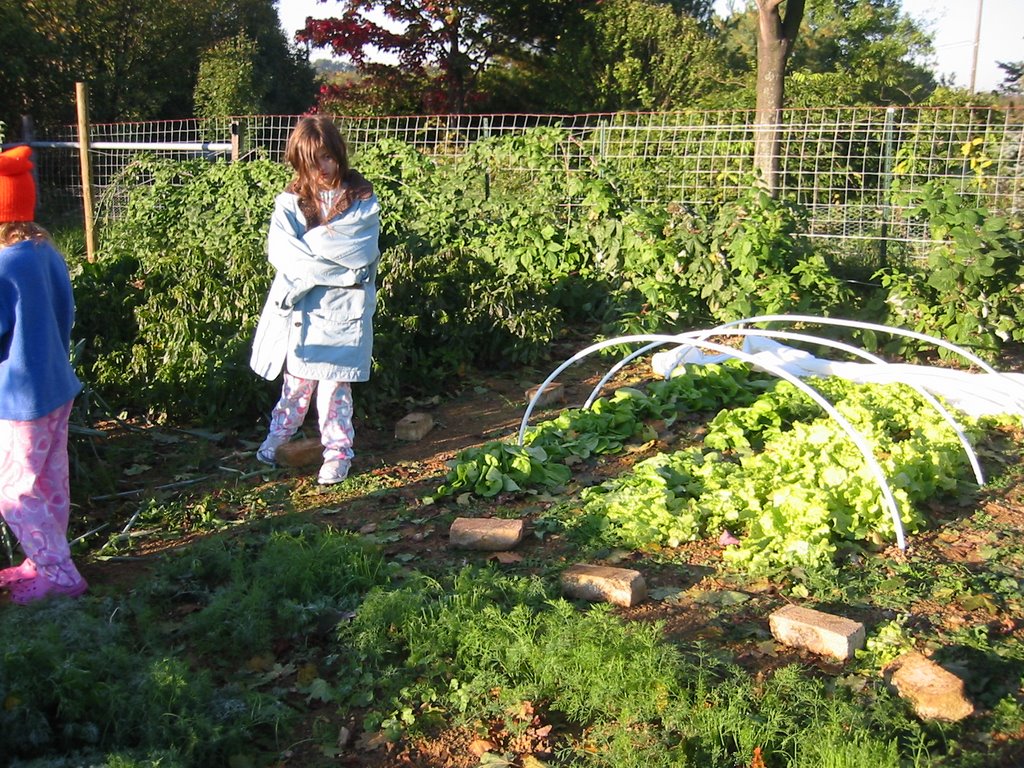
We had our first frost this week, and I'd come up with a pretty good plan for protecting our late season crops. I found some pex piping, water pipe, that comes in 100' rolls at the local home improvement warehouse. We were able to cut that to length pretty easily with a pipe cutter to create a low hoop-style row cover, which I then covered with some old sheets.


Voila! Instant row cover, which worked quite well and none too soon. Being outside, working together and watching the cold front move in—the change in the light, the sky, the wind, the temperature—was really amazing. The next morning the basil was totally zapped anywhere that wasn't insulated. The beans were a bit more hardy, but the new growth still took a hit.

We harvested the last of our green tomatoes and green peppers, and I just put up a huge batch of green beans. I was able to save the basil from the middle of the plants and pull together one last big batch of pesto for freezing, and I got a bunch of this second batch of dill vacuum sealed and frozen to pull out over the winter—it makes a delicious dijon sauce for salmon among many other things. Jules is going to miss coming out in the morning to harvest raspberries, but man, is she going to love it next year when we hopefully have more than just a handful. I can't wait to make jam!

Friday, October 06, 2006

Ahimsa

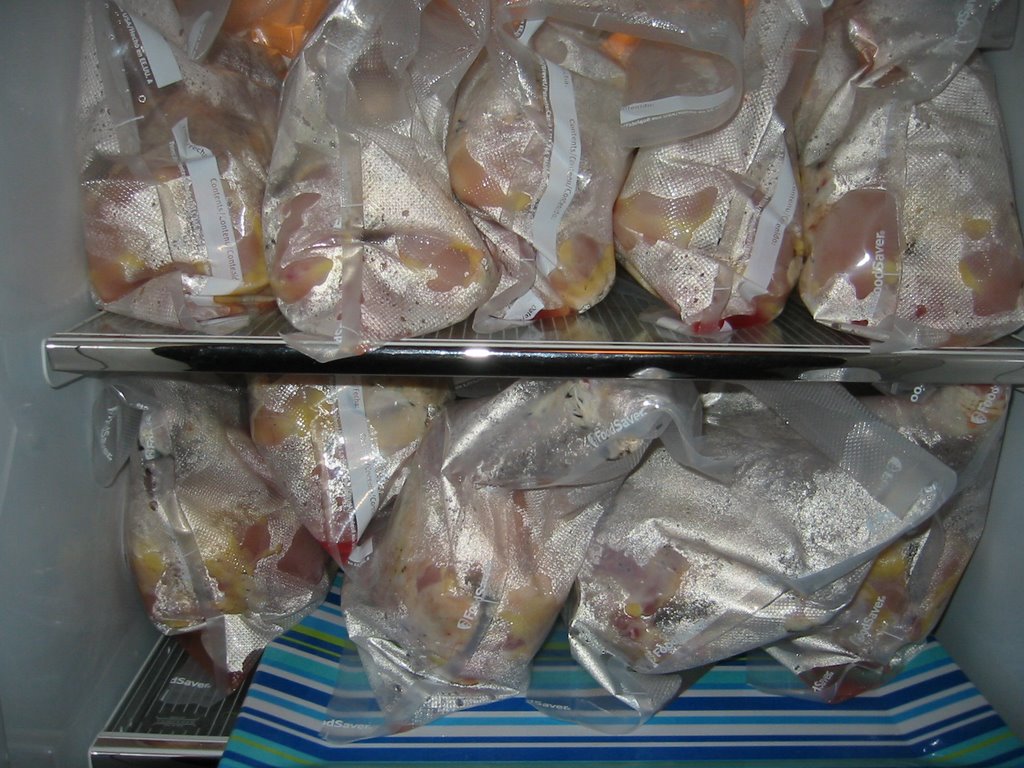
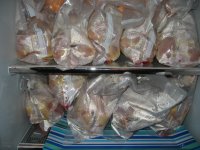
I know, I know. How can this photo possibly have any bearing on ahimsa?

Well, it's complicated—as is life.

Before I continue, I wish to recognize that much of what follows is a compromised version of ahimsa, but this version is what works for my family where we are, a crucial factor in my private definition and reasoning.

Exploring a Buddhist path for myself has meant multiple things to me at different times: it has meant vegetarianism and daily meditation; it has also meant mindful meat eating and meditation through living.

After a year and half of practicing vegetarianism while my family continued to enjoy meat, I found myself at a crossroads, needing to redefine where my practice was heading and how my family fit into it.

First and foremost, I am a householder, a role that is fundamental to my being and crucial to my interpretation and assimilation of the dharma. I came to a point where I needed to ask myself where I stood in relation to my commitment to vegetarianism and how that would impact my relationship with my family.

Was I, for instance, willing to force my own values on others, and if so, wasn't that a form of violence? If I was not willing to do this (which I was not), then I found myself face to face with the dilemma of what kind of meat my family would be eating and what role I was willing to take in supporting that consumption.

As I meditated on the dilemma, I determined that I could continue to buy grocery store meat, which supported the factory farming methods I loathed; I could expand my search for local sources and continue to pay top dollar for someone else to do the difficult work and take on the karmic pricetag for me; or I could consider raising the meat ourselves, which would not only ensure the quality of life and meat, but which also held the potential to transform my own family's relationship with the meat on their plates.

Raising our own meat, I reasoned, would put us all face to face with the animal whose life we were taking, creating the opportunity for each of us to become more mindful of what the meat on our plate meant—where it came from, what went into raising it, and how it was to honor that life even in the taking of it.

Also to consider was the affect my journey was having on my relationship with my husband. While he was not seeking to impose his values on me any more than I sought to impose my own upon him, he nevertheless mourned the loss of what he considered a valuable commonground and source of joy and connection in our relationship: the mutual creation and enjoyment of gourmet meals, along with the wine and meat that are a large part of that lifestyle for him and for us as a couple for more than ten years of our lives.

I had changed my path while he had not, and though I was free to continue my journey into Buddhist philosophy, I needed to find a way to do so while also honoring the path on which I already walked hand in hand with those I love. At what point, I asked myself, was I doing more harm by putting my values before my relationships than I would be doing by finding a way to live them together?

My own journey into homesteading has much to do with my desire to feed my family in a way that's both healthy and humane while also nurturing the earth that supports us all. By raising our own meat, as well as other food, we all have a new found respect for the life it represents and the level of care and effort that goes into bringing meat to our table.

By raising our own meat, by being responsible rather than abdicating that role to others, we are able to honor life itself by becoming more mindful of what and how much we consume. Our meat consumption has drastically reduced, and we no longer support large-scale meat production or consumption.

Ahimsa, I believe, looks differently for those walking different paths. This is what ahimsa looks for me on this lifepath that I walk at this moment.

This photo, this refrigerator full of chicken carcasses, represents the humane treatment and processing of poultry. It represents the mindful consumption of meat throughout the year, as it requires careful consideration of portion size and meat-oriented meals, as we've consciously increased the number of our vegetarian meals while reducing the number of carnivorous meals.

No longer does the bulk styrofoam package of boneless chicken breasts translate into two weeks worth of meals instead of the 14 chickens it really represents; instead, we see it for what it is. We do the math in our heads and consider how ludicrous it would be to attempt the harvest of a chicken breast per person per meal—how wasteful and wanton that would be on a practical level.

As we move closer to the production of our own food, we become closer to the value of life itself and closer to the earth that sustains it. That, to me, is a version of ahimsa—not ahimsa for a monk, certainly, but a version of ahimsa that works for my family in this moment, honoring the spirit of the precept if not the letter of the law.

Thursday, October 05, 2006

Oven-dried tomatoes

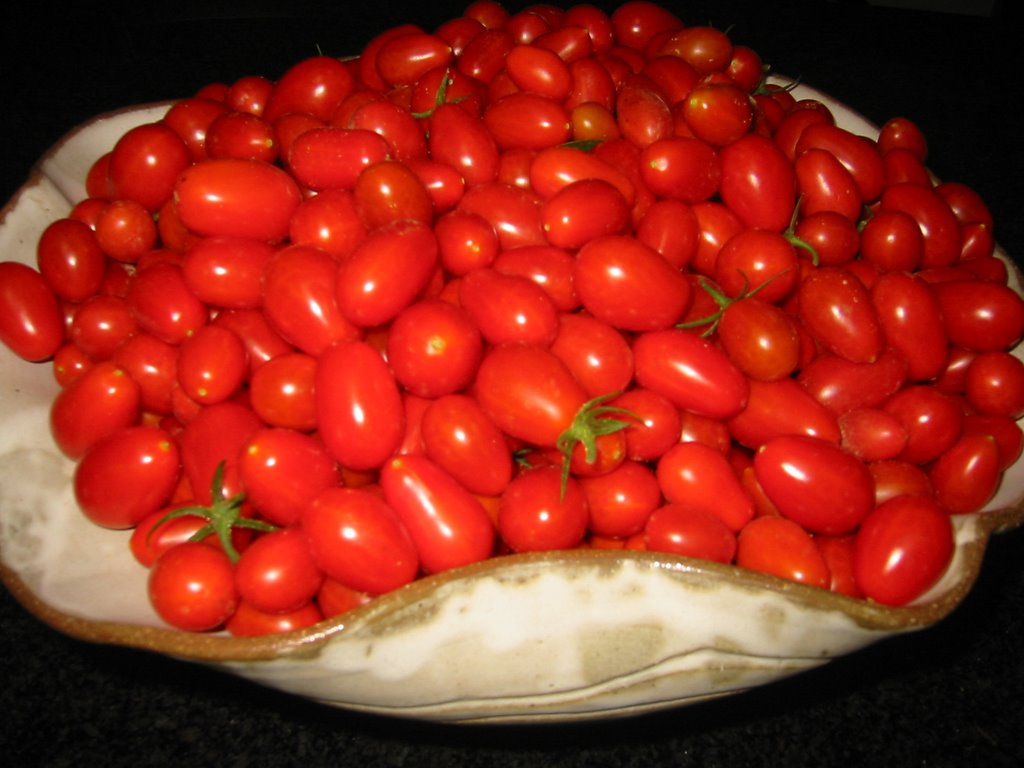
Finally, I have time to post again--whew! Before the Live and Learn Conference I harvested and processed as much as I could, just so I could be away for a few days without worrying about all that was going on in my garden without me. Obviously, I made lots of paste and whole tomatoes from the San Marzanos, and I froze many of the sungolds raw. The grape tomatoes weren't quite as big as I would hoping they would be. I'd planted them, hoping I could stuff them with some goat cheese like cocktail tomatoes, but they were pretty small and not as good fresh, imo, as the sungolds.

It began to look as if they would languish on the vine, so I decided to try drying them. Not wanting to buy a dehydrater, I made do with my ovens, though they only go down to 170 degrees, not the 140 recommended by most sources. I left them in for somewhere between 12 and 24 hours, and though not all of the tomatoes dried completely, the ovens did a pretty good job.

When all was said and done, I couldn't have sealed the oven-dried tomatoes for dry storage because of the moisture still left in several, but they turned out to be absolutely delicious! I opted to vacuum seal and freeze them and look forward to trying them out this winter. I'll definitely be planting these again next year, as Jim and I love sundried tomatoes on sandwiches and in pasta. How wonderful to be able to use those from our very own gardens!