Monday, April 16, 2007

Dry Curing Pork

We took our pigs into the butcher on Monday, April 9th, which was quite an adventure. I picked the meat up Wednesday and began the dry-cure process on Thursday. Tamworth's are known as the "bacon pig," and by the looks of this bacon belly, I can see why. I just hope it tastes as good as it looks!

For the cure, I used a mixture of salt and brown sugar, intentionally leaving out the nitrates. Raising our own meat in order to have as natural a product as possible, and then injecting it with a bunch of nitrates/ nitrites just made no sense. Our butcher offers a city cure, a common mass production method in which a liquid salt/ nitrate brine is injected directly into the meat. Yuk! So, I began to investigate other possibilities. I couldn't find any local smoke houses, so unless we built our own smokehouse, which may happen some day, that wasn't an option. Having grown up with Virginia ham and biscuits, a dry salt cure was the obvious choice, and I sure appreciated Contrary Goddess's recent post on salt curing, which made it seem all the more doable for little ol' me.
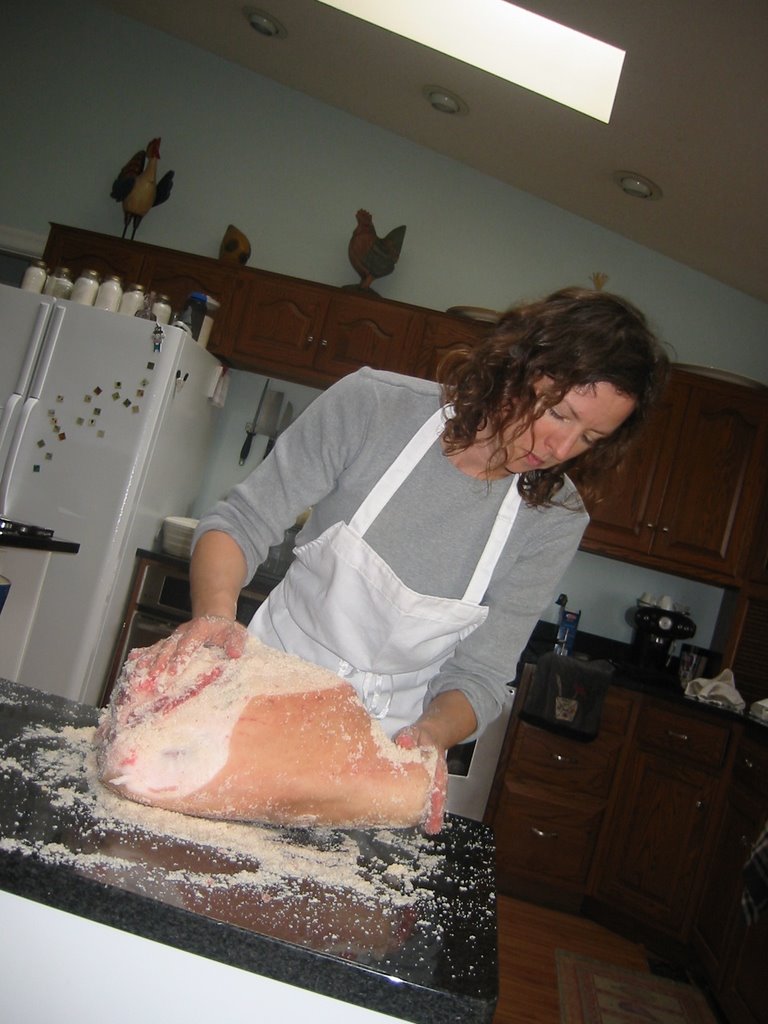
I rubbed the salt/ sugar mixture into the hams and the bacon slabs, which I cut into manageable sizes for eating and storing. Since we butchered our pigs in April, being from a fall litter rather than a spring litter, we're curing in the bottom of our second fridge instead of using the traditional method of letting Mother Nature provide the appropriate temps—and considering the extended warm weather we enjoyed early this season and the current extended cold, we may have needed the fridge no matter what! I didn't weigh out the hams or the belly, but we probably have close to 80lbs of meat curing. The pigs were 458 live weight, but we didn't get a hanging weight on them. Because we got so many roasts, we ended up with just 15lbs of sausage from the two of them combined, which I mixed up on Friday and vacuum sealed in small packages of loose ground. Before I sealed it, though, I fried up a small patty to check the taste—mmmmmm! It sure was good, and I can't wait to try some of our salty bacon!

Sunday, April 08, 2007

Happy Birthday Babies!

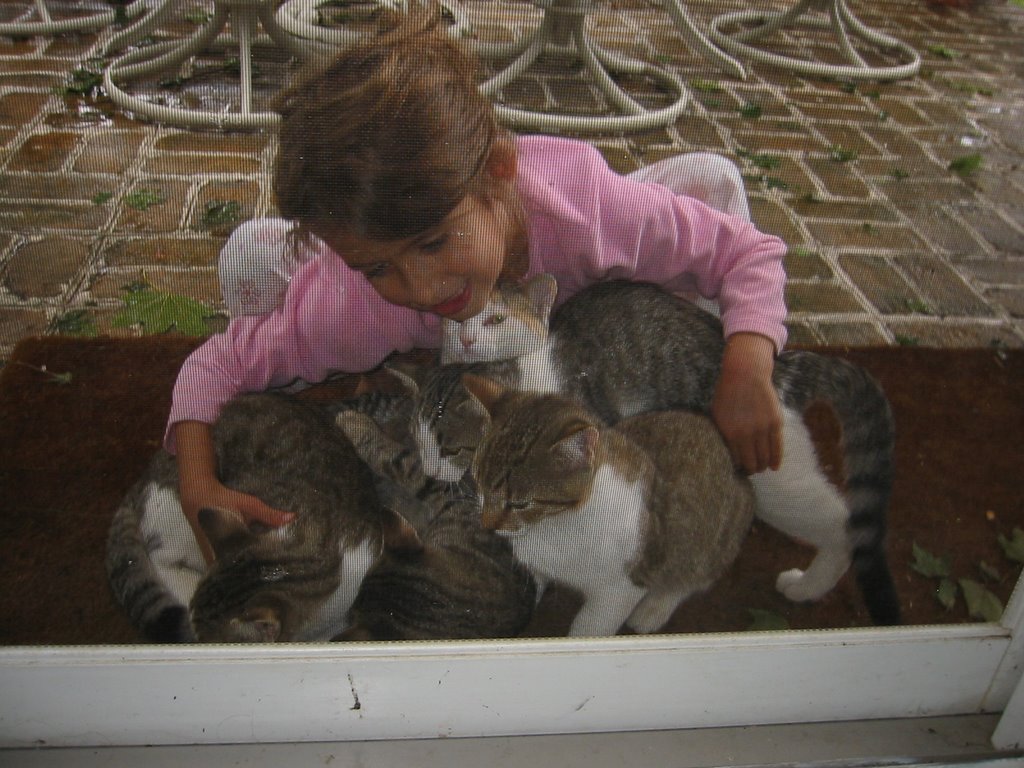
A year ago last week, we began our adventure of falling in love with a litter of kittens. Delivered by a stray cat who'd adopted our next door neighbors, they quickly became our responsibility when the mama had to be put down. The experience of hand raising these babies not only cured me of any left-over baby lust I had, but also turned out to be one of the best experiences the kids and I could have enjoyed. These kittens have graced our lives in so many ways.

We fell in love with each and every kitten, and each one is still so incredibly friendly. Our babies come running when we call, wrap themselves around our legs, climb in our laps, leap down from the loft when we least expect it, and heap up in one great big lump of purr when it's feeding time.

Hand-raised barn cats are way better than the typical feral barn cat fare found on most farms. They're no slouchers when it comes to catching rodents, averaging at least one "present" per day. The barn is, best we can tell, completely rodent free, the credit for which goes entirely to the babies. When they were only a couple months old, the mice were beginning to take over, evidenced by the fact that I easily caught two mice in a feed bag one morning which I promptly gave to my babies for play and training. They bring down whole rabbits, mice, voles, moles and shrews, and thankfully get very few birds since the rodents keep them busy enough. I wouldn't trade my babies for anything—they're fuzzy and loving and way better than any traps or chemicals could be!

**editing to add that they have all been spade and neutered and are up-to-date on their shots.

Saturday, March 17, 2007

On the hardiness of cold frames

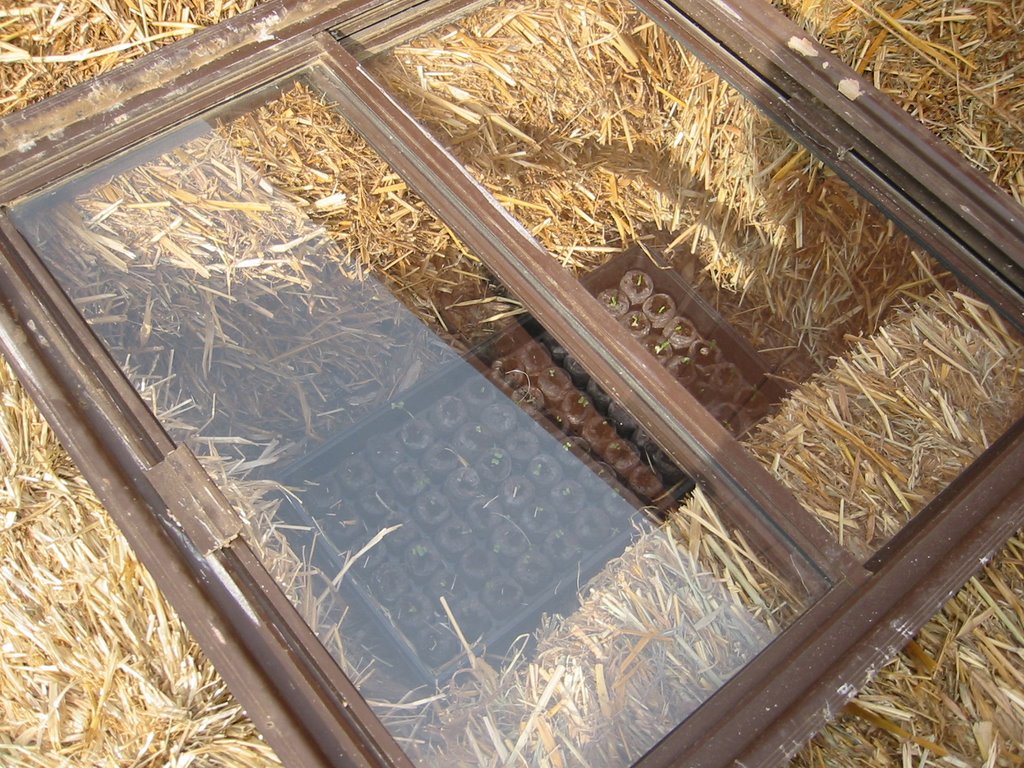
We started seeds on the 4th, letting them germinate in our kitchen window and moving them out to a strawbale coldframe shortly after. I find it's easier to use the sun's light and the straw's warmth than to try to replicate those conditions inside. I think it helps prevent legginess and to make hardening off easier. So, we tossed together 4 bales of straw and threw a window we removed from the barn when we built the coop on top to create a quick and easy coldframe. We were planning to have several long old Victorian style windows from my father-in-law as he's been replacing all their old windows at the beach house. Imagine my shock and dismay when he told me he'd put all those beautiful windows out by the curb for trash pick up!

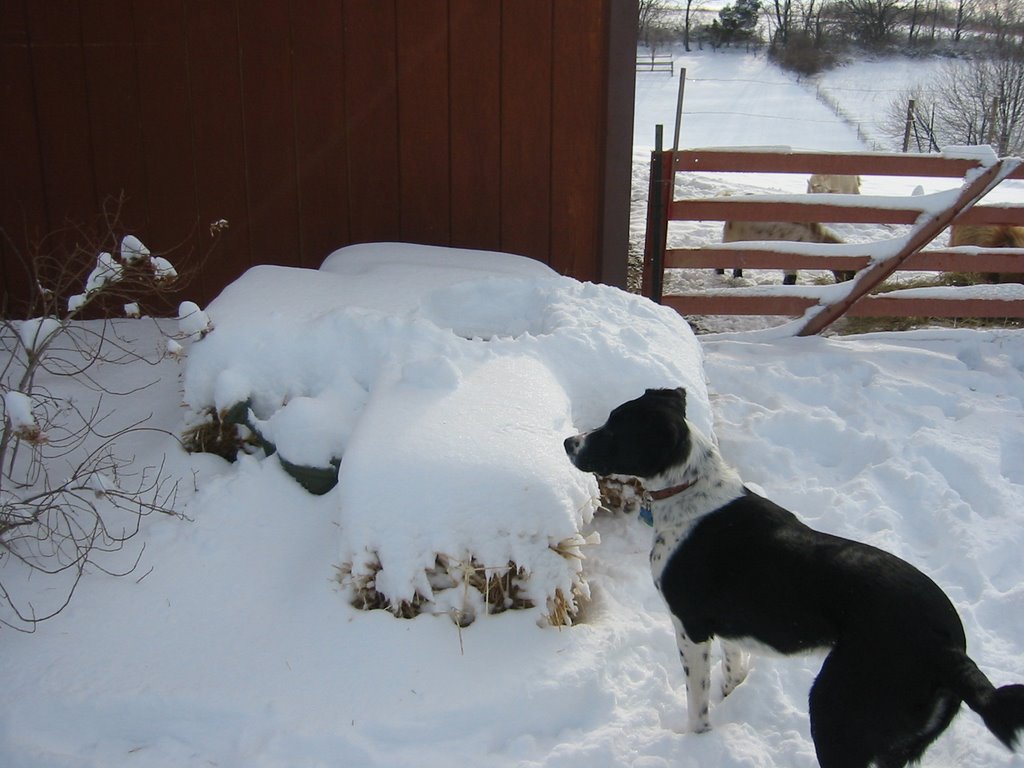
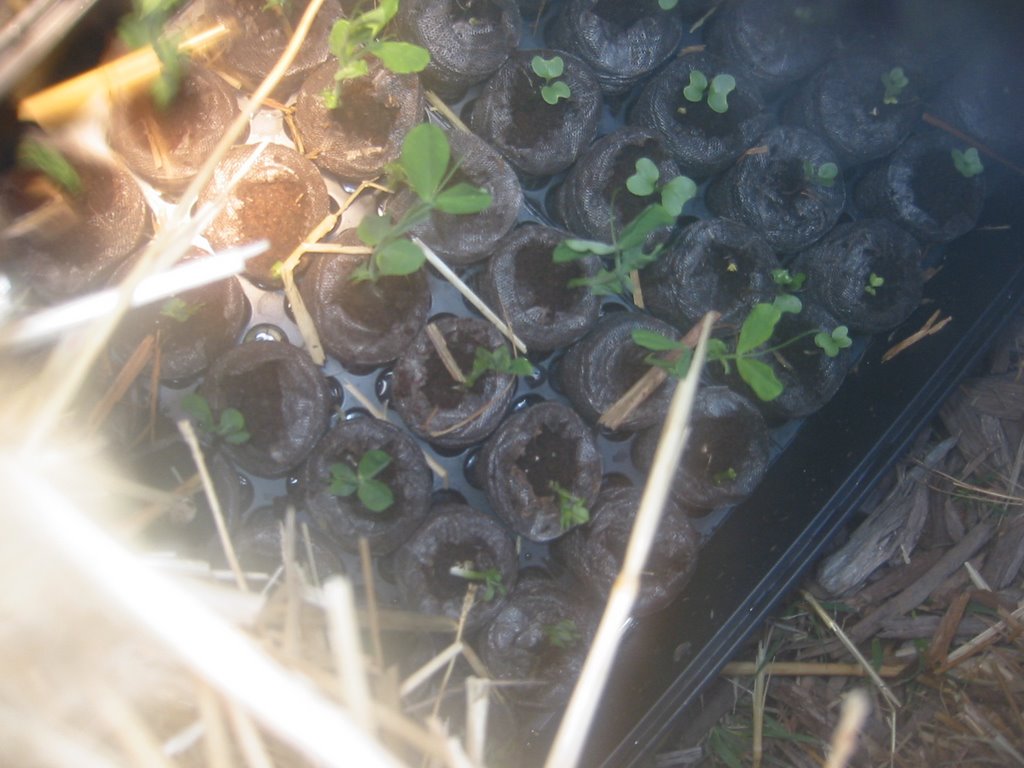
To the right is the coldframe this morning after 6 inches of snow and temperatures in the 20s. I was hopeful, but not confident as I went out to check on them this morning before feeding and watering the animals. Here are the seedlings as happy and warm as can be!

You can see peas and broccoli raab poking their heads toward the sun. I'll probably shovel some snow back on top this evening to help insulate through the night, as our temps are supposed to drop again. My biggest concern was the fluctuation, as we enjoyed temps in the 70s last week. Thankfully, the earth was nice and warm, which probably helped these little guys weather the storm in their nice cozy straw house. Those three little pigs gave straw a bad name!

Wednesday, March 07, 2007

What do you get when you cross a human with a grain of rice?

No, really, it's not a joke, and there's no punch line—unless of course, one finds humor in the exploitation of the sick, the tired, the poor, the hungry, the teeming masses, well...you get it, I'm sure.

The first genetically modified food to contain human genes has been developed by the California-based Ventria Bioscience company and is set to be approved for commercial production, as the USDA has approved preliminary production in Kansas. Researchers have managed to create a rice that produces some of the proteins found in human saliva, tears and breast milk, touting the creation as boon to treating children with diarrhea, a major killer in developing nations. Indeed, a recent company-sponsored study in Peru conveniently found that children with severe diarrhea recovered a day and a half faster if the fluids prescribed were spiked with the same proteins engineered into the rice.

According to a recent article in the British Daily Mail by Sean Poulter, "The rice is a major step in so-called Frankenstein Foods, the first mingling of human-origin genes and those from plants. But the U.S. Department of Agriculture has already signalled it plans to allow commercial cultivation."

Not to be outdone, Japanese researchers are developing rice with human genes that act as protection against agricultural herbicides by enabling the plant to break down harmful chemicals applied to soils.

Read more:
Washington Post
Daily News
Independent Science Panel
Live Science
Science News Online

Monday, February 12, 2007

Herb and Cheese Frittata

Made with farm fresh eggs and herbs, this is a great way to use up extra eggs and slightly stale bread.


10-12 eggs
1/2 cup of milk
ripped bread cubes to cover bottom of pan
sauteed, caramelized onion
fresh rosemary, parsley and thyme
grated gruyere
minced garlic
salt and freshly ground pepper to taste


Pour the egg milk mixture over the other ingredients layered in pan, bake at 350 for about 40 minutes. Remove from oven and let set for another 5-10 minutes before serving.

Baked frittata is delicious with a whole host of ingredients from broccoli to sundried tomatoes, and it makes an excellent catch-all dish to clean out the fridge.

Wednesday, February 07, 2007

Ode to the Barn Coat

It's been friggin' cold here for the past week. My small ornamental pond is, we think, frozen solid through. So much for the fish. I think the larger pond is still okay, though we had to turn the pump off because the water could no longer flow through the frozen filter in the skimmer box.

Admittedly, I'm a total wuss when it comes to the cold. I just don't like it, and I've completely released those dreams of a beautiful New England farmstead as I freeze my rear off in the mountains of mid-Atlantic Maryland. I'm not even north of the Mason-Dixon line, for heaven's sake, and I've decided that I never will be! This is as far north as I go. It's not just the growing season thing anymore; it's the Danielle doesn't like the bitter cold thing.

The water has been freezing overnight and during the day, so we've been changing the water out 2-3 times a day for the animals. The other morning I took two chicken waterers out with me that had defrosted inside overnight. I fed the cats, our three goats, and walked down to feed the pigs. By the time I got back, the bases had frozen on again, and I couldn't get them off. I made due with the rubber tubs, which are much easier to deal with in the winter because we can just toss them upside down and give them a good stomp to get the ice out. The piggies have all these little mini ice blocks strewn about their pasture from the past week—it looks as if we went a little crazy with the salt licks.

My one saving grace has been my glorious barn coat—lined with thick, nubby, sherpa fleece, my barn coat is my best friend. It's warm, soft, durable, and does an excellent job of keeping out the bitter wind. I love my barn coat! When the barn door froze in place, and I leaned into it to get out—a little too hard with eggs in my pockets—my barn coat didn't mind a bit and kept that goopy mess nicely contained within the pocket, just waiting until I got inside and could turn it inside out in the mudroom sink to give it a nice wash.

Wednesday, January 31, 2007

NAIS "opt out" clause?

Could the government be listening to the small, local farmers and livestock owners? Dare we believe that our voices have carried on the wind all the way to Washington?

Here's a rather interesting email forward I received today on a local list, especially considering that I just read Joel Salatin's rant about the lack of an "opt out" clause in The Omnivore's Dilemma.

USDA provides an "OPT OUT" procedure for NAIS

In a dramatic reversal of policy, the USDA has decided to provide an "OPT OUT" procedure for people whose premises have been registered in the National Animal Identification Program. Complaints have continued to mount in several states from landowners who have discovered that their premises were registered in the NAIS without their knowledge or permission. On Friday, January 26th, Ben Kaczmarski, a spokesman for USDA's Animal and Plant Health Inspection Service, told the Liberty Ark Coalition, http://libertyark.net, that the USDA has decided to provide an "opt out" procedure. Even though the protocol has not yet been fully defined, Kaczmarski said the procedure would require a person who wants to opt out, to write a formal request to be removed from the NAIS, to the state NAIS coordinator. This procedure, not yet published by USDA, would require the state NAIS coordinator to confirm the validity of the request, and advance the request to USDA. The USDA will then, presumably, remove the name from the registry, according to Kaczmarski.

State NAIS coordinators can be located at this website: http://animalid.aphis.usda.gov/nais/contact_us/directories.shtml.

The new "OPT OUT" procedure was received with enthusiasm, and skepticism, by the farm and ranch community. "Many people are sure to file requests for removal of their premises from the NAIS registry in the coming weeks," said Judith McGeary, a member of the Liberty Ark Coalition Steering Committee. "And we are set up to monitor the process to see just how long it takes, and what bureaucratic obstacles have to be overcome."

"Opponents of the NAIS are skeptical because the USDA has a history of saying one thing to the public," says McGeary, "while doing quite another thing behind the scenes."

Another Steering Committee member, Randy Givens, says: "Everyone in the grassroots community should take heart at this evidence of their joint efforts, but people should also remember that this is a proposed protocol that can be changed at any time. This opt-out procedure is just one aspect of the evolving plans for NAIS at both the federal and state levels."

Opposition to the NAIS forced the USDA to renounce its planned time-line to make the NAIS mandatory starting in 2007. The new USDA policy calls for a "voluntary" NAIS, but behind the scenes, the USDA has poured funds into states that worked to make the program mandatory at the state level.

Another tactic being recommended by the Animal Identification Committee of the United States Animal Health Association is to create a list of "Consistent States" that require official identification of all breeding cattle. States not on that list could face restrictions of interstate commerce. Though this recommendation has not been adopted by the USDA, these behind-the-scenes maneuvers give credence to the concerns of NAIS opponents as to the sincerity of the USDA's announcement that the NAIS is, and will continue to be, a voluntary program.

Sincerely,
Pat Stewart